


At TIC Software, we began working seriously with generative AI in 2023. Like many others, we experimented with tools such as ChatGPT, Gemini, and Claude, but our focus was very specific: how could this new class of technology help Nonstop teams analyze, document, and understand complex application programs?
That work led to the introduction of our Navigator product in 2025, one of the first AI-powered products designed specifically to improve development productivity for Nonstop developers. Since then, more people in the Nonstop community have started learning about AI and exploring how it can help with documentation, onboarding, modernization, and knowledge preservation.
That is a good development. AI can be a powerful tool. But as more teams begin using AI, it is important to understand not only what AI can do, but also what we need to be careful about. The most important lesson we have learned is this: AI alone is not enough.
LLMs Are Powerful But Stochastic
Most of today's AI tools are powered by large language models, or LLMs. These models are very good at explaining complex topics, summarizing large amounts of text, answering questions in plain language, and helping developers move faster. For Nonstop teams, that is exciting because so much of our application knowledge is buried inside source code, copybooks, procedures, operational scripts, and the experience of long-time subject matter experts.
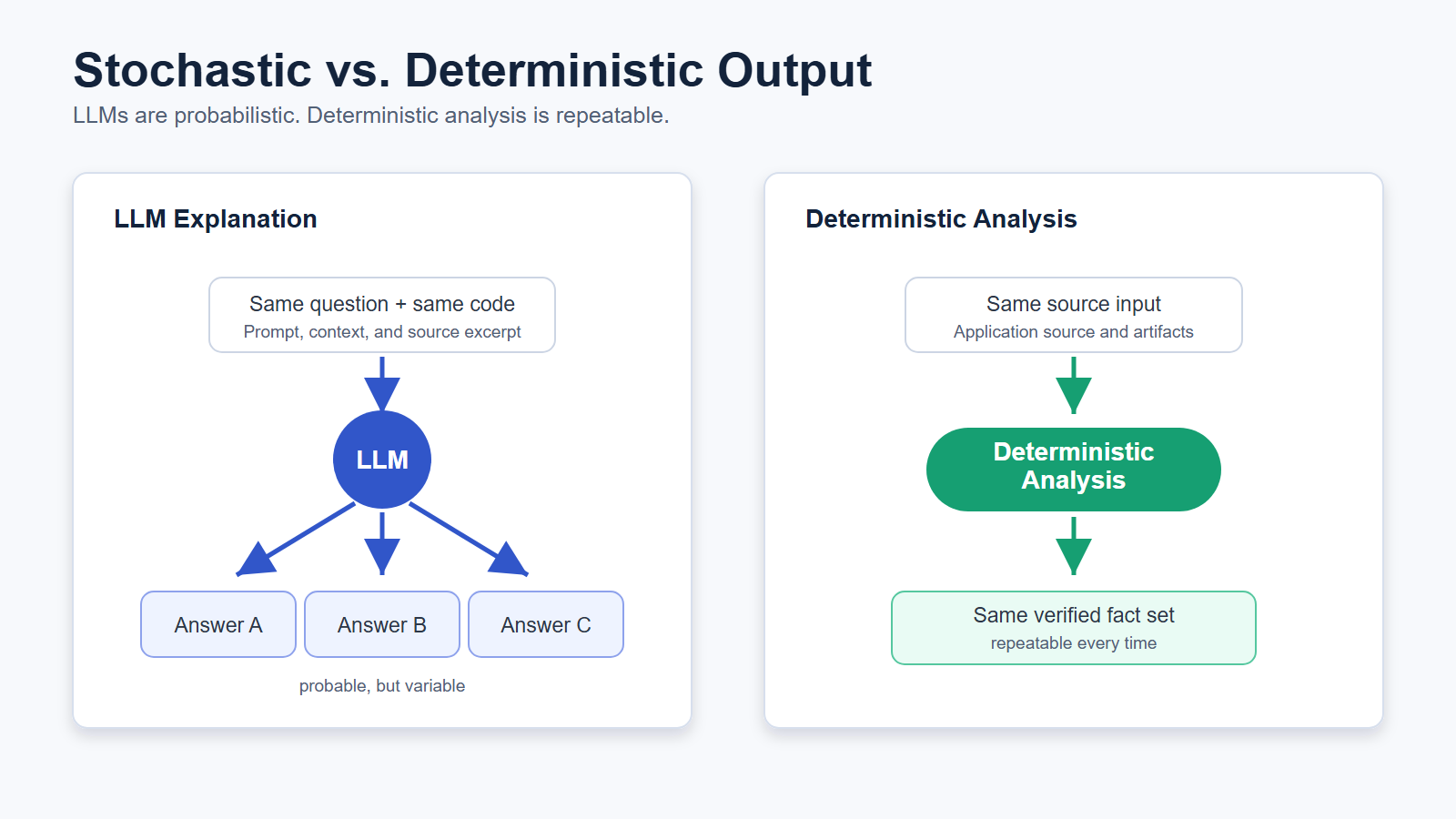
However, an LLM is not the same as a compiler, parser, cross-reference utility, or static analysis tool. LLMs work differently. They are stochastic systems. In simple terms, stochastic means the answer is generated based on probability. The model predicts what words are most likely to come next based on the prompt, the context, and the patterns it has learned. That is why an LLM can produce a clear explanation of a difficult topic. It is also why the same question can sometimes produce slightly different answers.
Why This Matters
Nonstop systems support some of the most important applications in the world, many of them built on decades of development work. The platform works. The code works. The business depends on it.
The challenge is that the knowledge around the code is often harder to find. Many experienced people are retiring. Teams need to understand what an application really does, where the business logic lives, how different pieces are related in order to maintain the code.
A hallucination happens when an AI system produces an answer that sounds reasonable but is not supported by the actual facts, such as:
- An AI tool might infer a business rule that is not really present.
- It might miss a dependency.
- It might explain one section correctly but miss the larger application context.
- It might confuse Nonstop-specific behavior with patterns from other platforms.
This does not mean AI should be avoided. It means AI should be grounded and surrounded with guardrails. The better question is not simply, "Can AI explain my code?" The better question is, "What facts is the AI using when it explains my code, and what process do we have to minimize hallucination?"
The Simple Approach - Human Review
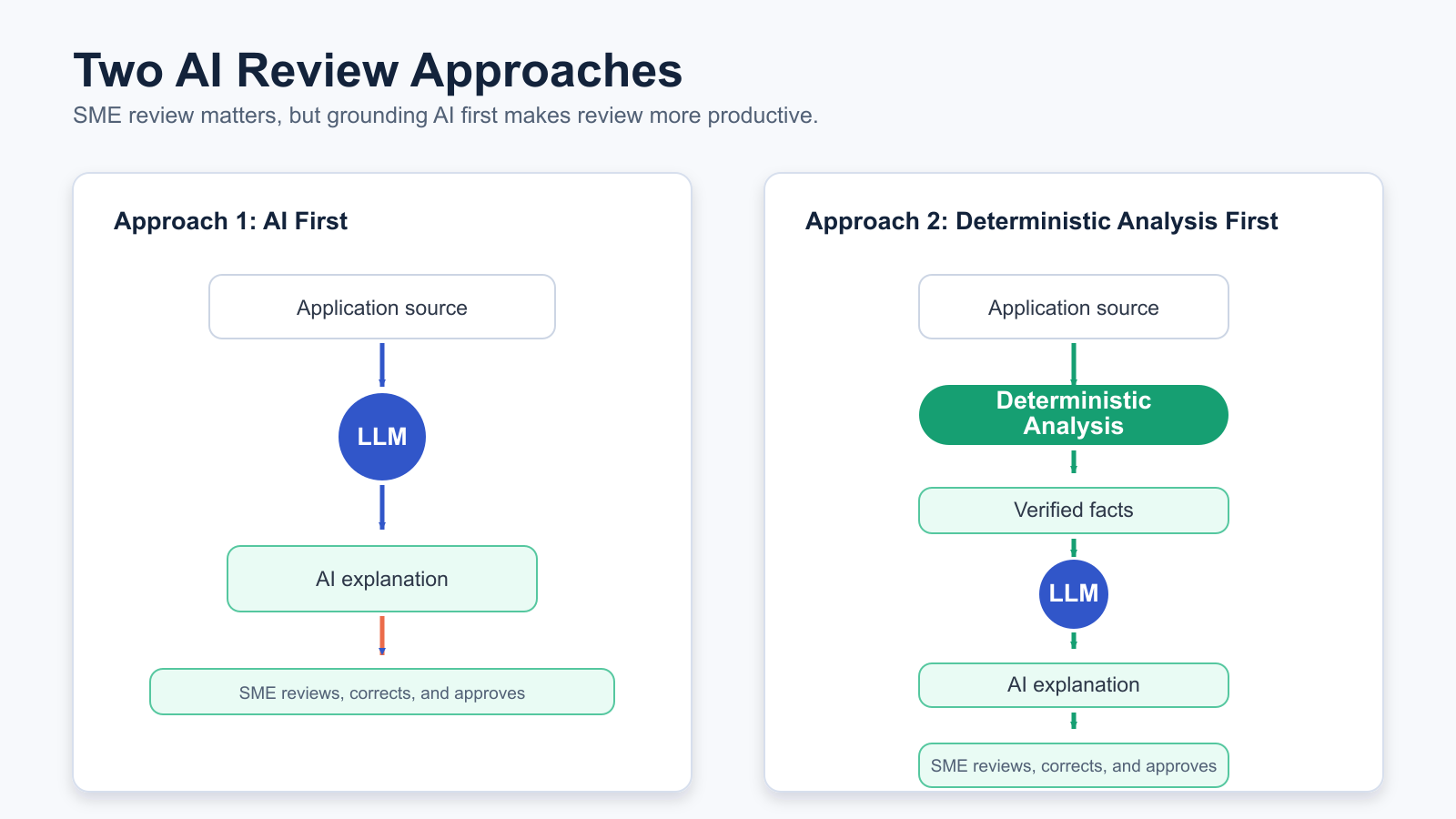
One possible approach is straightforward: give code or documentation to an LLM, ask the LLM to explain it, and then ask an SME (Subject Matter Expert) to review the answer. This is better than using AI with no review at all. Human review is important, especially in mission-critical environments.
But in practice, this approach has limits. SMEs may have to spend too much time to determine what is right, what is wrong, what is missing, and what is only partially true. At that point, the review process can become almost as difficult as writing the documentation manually.
Relying solely on SME review is not scalable. Many Nonstop organizations have only a small number of people who deeply understand their legacy applications. If every AI answer requires a senior SME to perform a line-by-line investigation from scratch, the organization has not solved the knowledge problem. It has only moved the bottleneck.
A Better Approach - Deterministic Analysis + LLM + Human Review
A stronger approach is to improve the input before the LLM begins. Instead of asking AI to guess from raw or incomplete context, the process should start with deterministic analysis. That analysis extracts repeatable facts from the actual application source and supporting artifacts.
This is one of the most important guardrails we can put around AI. If the model is guided by verified facts before it generates an explanation, we reduce the opportunity for it to invent missing details. We do not eliminate the need for review, but we make the review more focused and productive.
Deterministic analysis is very good at producing repeatable facts, but it is not designed to explain those facts the way a person would. It can perform static analysis to determine:
- How are the components (paragraphs, procedures, functions) related?
- Where are the dependencies (program to program, file to program)?
- What areas may be affected by a change (program/file/library)?
Once that factual foundation exists, AI can use it to do what it does best: explain, summarize, organize, and make the information easier for people to understand. The SME is still essential, but the expert is now reviewing a fact-grounded explanation instead of a blank-slate AI answer. That is a much smaller and more valuable job than reviewing unsupported output from a stochastic LLM.
AI Plus Human Equals Increased Productivity
Some people worry that AI is intended to replace developers. I do not believe that is the right way to think about AI in the Nonstop community. AI should be treated as a tool, and more specifically, as a productivity tool used by human developers, analysts, architects, and support teams. Nonstop experts still matter because they understand the business context, operational history, production behavior, exceptions, special cases, and the reasons certain design decisions were made. AI does not automatically know those things. It can help organize and explain information, but it does not replace judgment.
The goal is not to remove the human from the process. The goal is to make human expertise more productive, more reusable, and more accessible across the organization.
The Winning Combination
For Nonstop environments, the winning combination is deterministic analysis, AI explanation, and human expertise. Each part has a different role.
- Deterministic tools provide repeatable facts.
- AI makes those facts easier to understand.
- Humans apply judgment, business context, and approval.
When these pieces work together, AI becomes much more valuable. It becomes more than a clever assistant. It becomes part of a governed knowledge process.
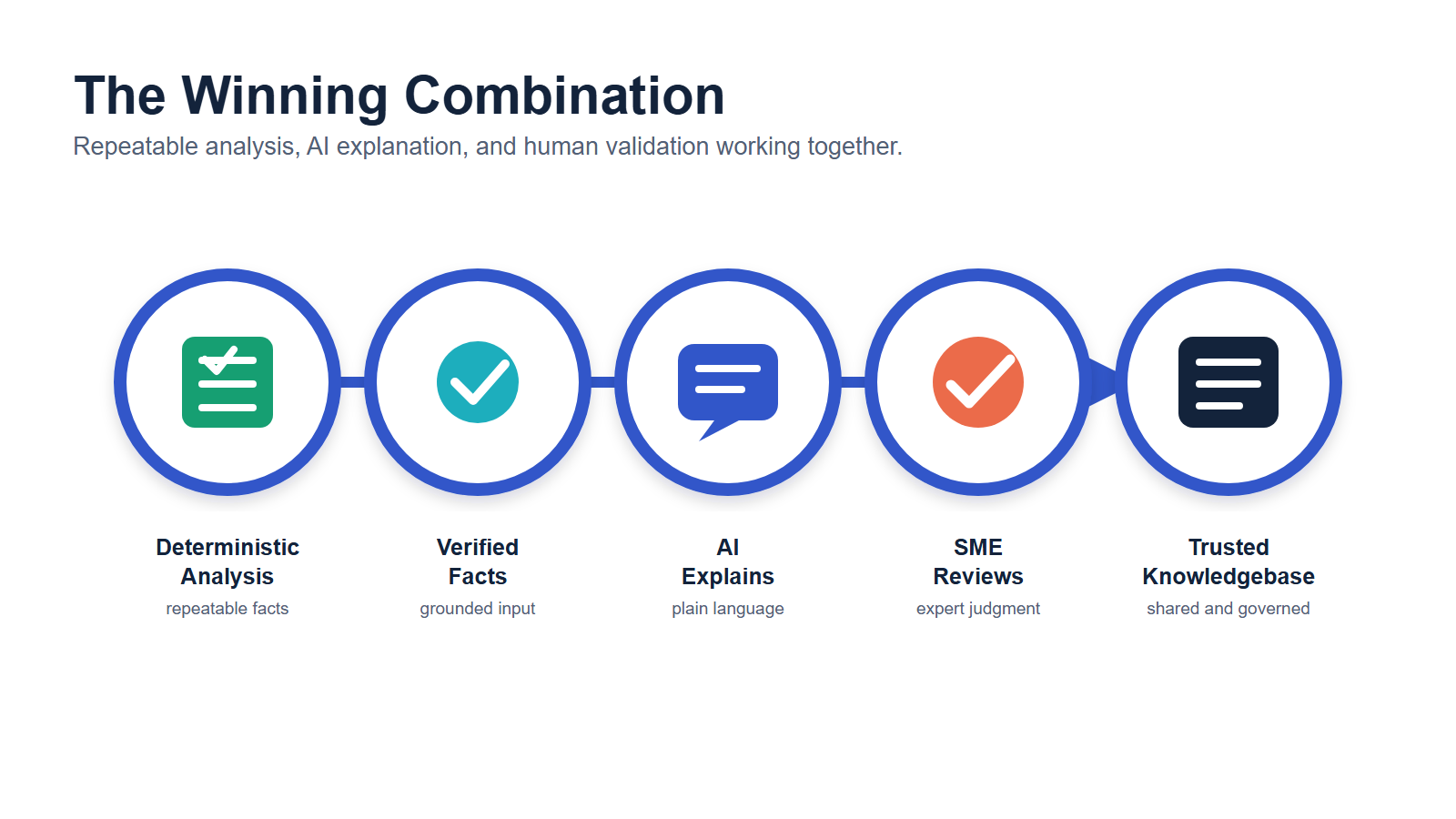
This approach also fits the reality of Nonstop modernization which involves: understanding the codebase, reduce risk, preserve knowledge and improve productivity. This combination allows us to leverage AI to modernize Nonstop applications incrementally and reliably.
TIC Software Strategic Approach
This is the strategy we have taken with Atlas and Navigator. Atlas provides deterministic analysis to establish a reliable factual foundation. Navigator applies AI to help explain, document, and organize that knowledge. SMEs then review and refine the result so it becomes trusted enterprise knowledge rather than just another AI-generated answer.
At TIC Software, we began researching and testing generative AI for Nonstop in 2023, and we will continue to evaluate the latest relevant technologies as they emerge. Our goal is to apply those technologies in practical ways that solve real Nonstop challenges, address enterprise customer needs, and help organizations extend the value of the Nonstop applications they already depend on.
In the next article, we will go deeper into how this workflow can work in practice.
Contact TIC Software
You don't have to figure this out alone. TIC Software has deep experience bringing AI to Nonstop environments — from code intelligence and documentation to chat-based debugging and modern development tooling. Reach out at sales-support@ticsoftware.com or request a demo. Let's map out the right path forward for your organization together.

Phil Ly serves as president of TIC Software and a recognized thought leader in the Nonstop community. Under his leadership, TIC Software has become the premier guide for Nonstop organizations adopting modern technologies, including REST APIs, Kafka messaging systems, and cloud services. Phil's expertise lies in bridging the gap between complex emerging technologies and practical implementation, making advanced solutions accessible to Nonstop professionals across all experience levels. As architect of the innovative Navigator platform, he is pioneering the integration of generative AI into Nonstop environments, demonstrating how AI-powered solutions can enhance system reliability while preserving the mission-critical security standards that define the platform.